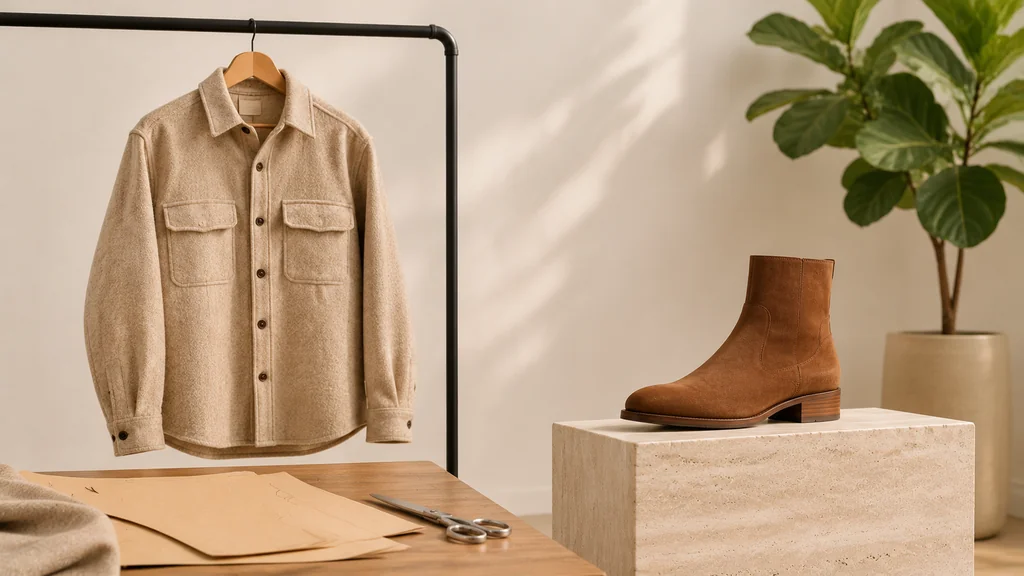
Choosing the best 3d product modeling solution for fashion ecommerce starts with separating what kind of fashion products you sell: soft sewn garments (dresses, shirts, knitwear, and outerwear that rely on pattern-based cloth physics in software like CLO 3D, Browzwear VStitcher, or Style3D) versus structured fashion accessories and footwear (sneakers, boots, handbags, watches, eyewear, and jewelry that rely on precision polygon modeling, 3D scanning, and physically based rendering—realistic materials and finishes—in tools like Autodesk Maya, Blender, and Adobe Substance 3D).
Done well, 3D modeling is a frontline weapon against fashion ecommerce's two biggest profit drains: the cost of shooting dozens of seasonal colorways and fabric variants, and an online apparel return rate that Coresight Research estimated at 23.4% in the U.S. in 2025 (up from an earlier estimate of 24.4% for the 12 months to March 2023, per Sizely's return benchmark summary).
Here is an honest, end-to-end breakdown of the fashion 3D ecosystem—covering which software and production pipeline fits each fashion category, how fabrics and color variants are calibrated so shoppers trust what they see, and when to hire an independent 3D studio instead of buying software seats.
One limit to keep in mind from the start: accurate 3D models can help shoppers inspect product details and understand proportions. Their impact on returns depends on the product category, the shopping experience, and the reasons customers return items. A 3D drape preview shows how a garment is designed to fall—it is not a guarantee of how that garment will fit an individual shopper's body.
Why Fashion Ecommerce Has a Visual Problem (and Why Returns Are So High)
According to the National Retail Federation (NRF) and Happy Returns 2025 Retail Returns Landscape report, U.S. retailers expected 19.3% of online sales to be returned in 2025. Apparel runs higher: a pre-pandemic survey cited in McKinsey's Returning to Order report found a 25% ecommerce return rate for apparel, and Coresight Research (cited in Sizely's return statistics) estimated 24.4% for the 12 months to March 2023 and 23.4% for 2025:
- ~70% of apparel returns were caused by poor fit or style, based on the experience of McKinsey's survey respondents (McKinsey).
- 53% of surveyed U.S. apparel brands and retailers named size and fit as a top reason for online returns, followed by color (16%) (Sizely / Coresight Research).
- 58% of online shoppers said they "bracket"—buying more than they intend to keep, such as several sizes or colors—in Narvar's 2021 State of Returns report (Sizely / Narvar data), and in a Narvar survey of online fashion shoppers, 49% said items looked different in person than online.
Why do flat 2D fashion photos leave shoppers so uncertain?
- Fabric can't be felt through a screen: A flat photo rarely shows weight, stretch, sheen, or grain direction, so shoppers guess at how a fabric or leather will actually feel and fall.
- Color shifts with lighting and screens: Studio lighting, retouching, and display settings all change how a dye or finish reads, and colorways that were never photographed are often shown as recolored images that don't match the real product.
- Scale and proportion confusion: Without a 1:1 Augmented Reality (AR) preview on accessories or accurate drape simulation on garments, buyers guess at proportions and return what doesn't match.
Comparing the 5 Major Fashion 3D Modeling Software Solutions
If your brand is evaluating 3D tools—either to understand what your production partners use or to equip an internal design team—you must match the software to the physical construction of your product.
| Solution / Pipeline | Primary Fashion Vertical | How It Builds the 3D Model | Published Pricing & Licensing | Best Role in Ecommerce |
|---|---|---|---|---|
| [CLO 3D] | Soft Sewn Apparel | Stitches 2D CAD garment patterns around parametric 3D avatars using GPU cloth physics ([CLO Comparison]). | $50/mo or $450/yr; custom Enterprise pricing for companies with 2+ staff. | Digital sampling, virtual fit checks (Strain Maps), and exporting 3D garments for renders or web viewers. |
| [Browzwear (VStitcher)] | Enterprise Apparel Brands & Manufacturers | Pairs 2D pattern drafting and 3D draping with hardware fabric testing and PLM integrations ([Browzwear Brands]). | Custom Enterprise Quotes | Large apparel brands reducing physical samples (Browzwear cites 50% fewer) and syncing 3D tech packs with factories. |
| [Marvelous Designer] | Digital Garments, Animation & Campaign CGI | Uses the same core cloth simulation technology as CLO 3D (both from CLO Virtual Fashion), with built-in retopology tools for cleaner real-time meshes and the EveryWear feature package (auto-fitting, rigging, and LOD generation) ([Marvelous Designer Licensing]). | $39/mo or $280/yr (Personal); Indie Studio & Enterprise network plans available. | Creating realistic cloth folds, animated garment motion, and optimized meshes for marketing CGI and web viewers. |
| [Style3D Studio] | Apparel, Knitwear & Virtual Merchandising | Combines pattern-based GPU cloth physics, knitwear simulation, and .glb/.fbx web exports, with AI-assisted features ([Style3D 2026 Review]). |
Free non-commercial plan; paid Individual & Enterprise plans for commercial use (AI features listed for Enterprise). | Fast digital garment prototyping, digital fabric libraries, and virtual showroom assets. |
| Polygon Modeling (Maya / Blender) + [Adobe Substance 3D] | Footwear, Handbags, Luggage, Watches, Eyewear & Jewelry | Combines precision subdivision/polygon modeling with procedural & scan-based PBR material authoring. | Studio Production Pipeline (or Adobe CC Business licensing; a Pfeiffer Consulting report cited by Adobe found up to a 90% reduction in hours and resources vs. physical photoshoots). | A flexible production approach for detailed footwear and accessory models, particularly when photorealistic rendering and optimized web assets are required. It produces studio renders and lightweight .glb/.usdz product-page & AR files. |
Software prices above are the license costs as published by each vendor (checked November 2026)—check the vendor's current pricing page before budgeting, as plans change. They are not directly comparable with the last row: a studio production pipeline is a per-project service that includes the modeling, materials, and optimization work itself, not just a software seat.
Working the Fashion Vertical End-to-End: Variants, Fabrics, and Returns
To see how a 3D pipeline actually operates for an online fashion store, break the workflow down across the three areas that matter most to your P&L: fabrics, variants, and product page delivery.
1. Getting Fabrics, Leathers, and Hardware Right (Beyond Color Codes)
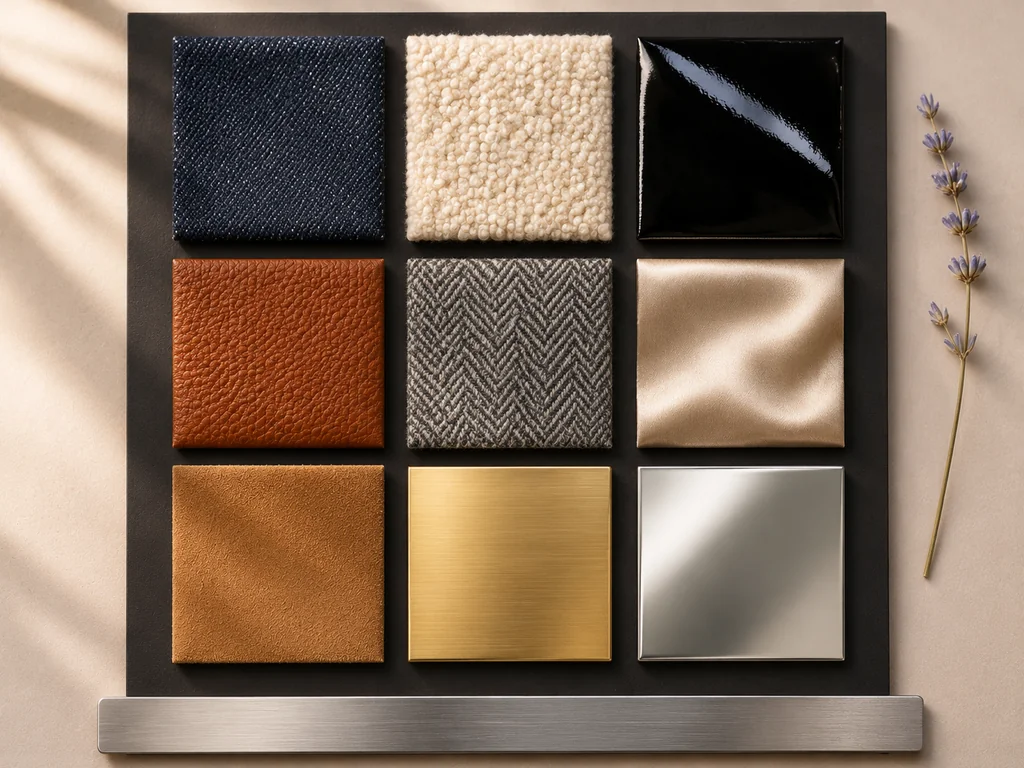
For a leather tote bag or a pair of suede boots, the visual appearance of the material can be central to a shopper's purchasing decision.
In a professional 3D workflow, fabrics and leathers are built as multi-channel Physically Based Rendering (PBR) materials—realistic materials that describe how a surface absorbs and reflects light:
- Micro-surface normal and height maps capture the visible depth of twill weaves, bouclé yarn loops, top-stitching thread, and pebbled calfskin.
- Roughness and sheen channels control how light scatters softly across brushed suede or velvet (
KHR_materials_sheenin glTF) versus how it reflects sharply off patent leather or polished brass buckles. - Calibrated 1:1 texture scale: As we detail in our studio guide on product material reference packs: giving a 3D artist evidence beyond a color code, placing a millimeter ruler beside your physical fabric swatch in a reference photo allows the artist to map the weave repeat at real-world scale—then check the result against the physical swatch, because a reference photo alone does not guarantee an exact match.
2. Scaling Colorways and Seasonal Variants Without Reshoots
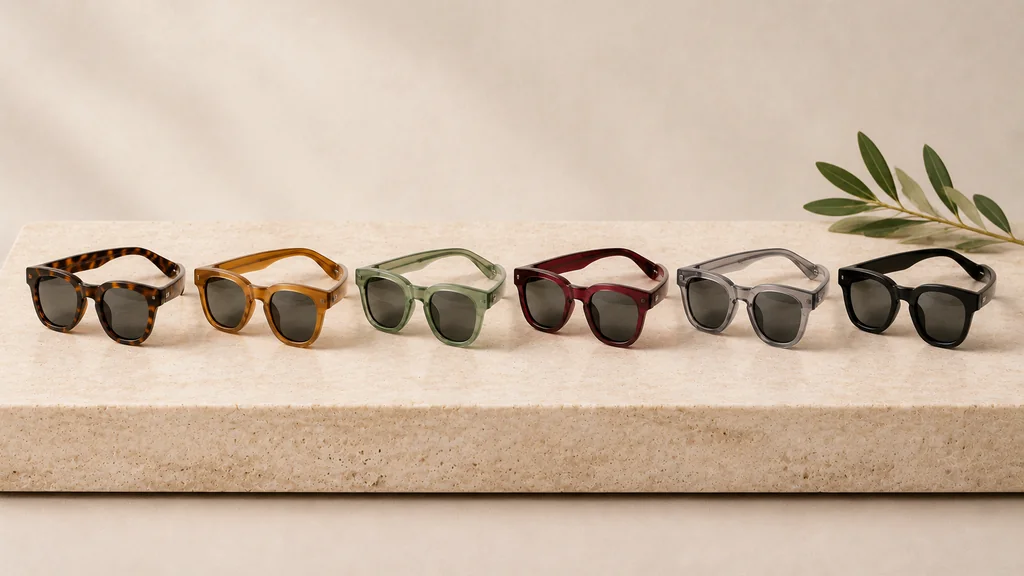
Once the master 3D model of a sneaker, handbag, watch, or jacket is built and its UV map (the layout that wraps the material images onto the model's surface) is laid out cleanly (with UV islands aligned to the real grain direction of the panels):
- Launching 8 seasonal colorways or swapping hardware from silver to gold does not require manufacturing 8 physical samples or booking a photographer.
- The artist simply applies the calibrated material presets to the named zones (
body_leather,piping_trim,zipper_metal,stitching_thread) and exports both the complete 2D angle gallery and the updated.glb/.usdzinteractive files.
This holds as long as the product's shape and construction stay the same—if a new season changes the silhouette, panels, or hardware design, the model itself needs new work, not just new colors.
For footwear and structured bags where a physical sample does exist, studios can also use controlled photogrammetry—covered in our walkthrough on capturing a physical product for 3D reconstruction with Apple Object Capture—as a dimensional base reference before retopologizing the mesh and authoring clean PBR shaders in Substance 3D Painter.
3. Delivering to the Product Page to Cut Returns
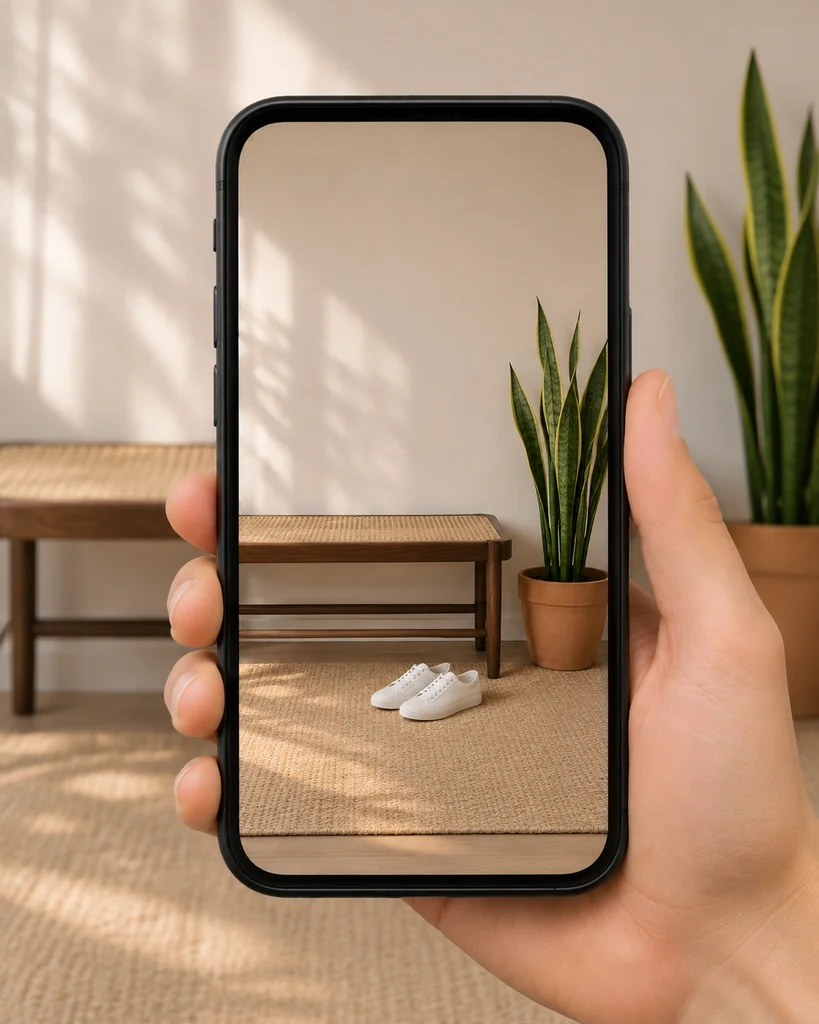
How does that 3D model actually help reduce your return rate on the storefront? It depends on the product type—and on which technology is doing the work. A 3D model on its own improves inspection; AR placement, virtual try-on, and size-recommendation tools are separate features that build on top of it:
- On handbags, luggage, watches, eyewear, and footwear: Embedding an interactive
.glbviewer (~2 MB to 4 MBper Shopify's 3D standards—a target range, since the right size depends on the model's complexity, textures, and compression) with 1:1 mobile AR lets the shopper place a bag or shoe on their desk or floor to see its true physical size and inspect every pocket and buckle (seeing eyewear or a watch on the face or wrist needs a separate virtual try-on tool). Handbag brand Rebecca Minkoff reported that shoppers who used AR were 65% more likely to place an order than those who didn't (Shopify AR Fashion), and footwear brand Zach Footwear reported a 29.4% drop in returns after adding 3D visualization, AR, and virtual try-on, in a case study published by its provider, Fibbl (Fibbl 3D Guide). These are individual brand results, not results every store should expect. - On soft apparel and sizing: For sized garments, pairing accurate 3D drape/colorway visualization with empirical size-recommendation tools targets both style-mismatch returns and size-related returns. In a controlled A/B test published at KDD 2021, Zalando's size advice cut size-related returns by 3.8% (per Sizely's return audit), and Zalando reports that its size and fit tools prevented 8% of size-related returns overall in 2025 (see also Photta's VTO report).
Software Seats vs. Done-For-You Studio Modeling: Which Should You Choose?
If you are a fashion brand deciding how to execute this, you have two choices:
- Buy software seats and build in-house: This makes sense if you have (or plan to hire) 3D designers and a steady stream of new styles every season. Garment teams typically work in CLO, Browzwear, or Style3D; accessory and footwear teams need a polygon modeling and texturing toolset. Budget for licenses, a capable GPU workstation, training time, and the optimization work required before files are web- and AR-ready.
- Hire a done-for-you 3D studio: This makes sense if you need finished assets—renders,
.glb, and.usdzfiles—without building a team, or if your volume is seasonal. You supply photos, measurements, and swatches; the studio handles modeling, materials, optimization, and delivery. Many brands combine both: an in-house team for garment development and a studio for marketing-ready accessory and footwear assets.
Neither route is automatically cheaper or faster: an in-house team pays off through volume and fast revisions, while a studio avoids hiring and setup—but both routes need accurate references and review rounds to get fabrics and finishes right.
Frequently Asked Questions About Fashion Ecommerce 3D Modeling
Can a raw CLO 3D or Marvelous Designer garment file be uploaded directly to Shopify?
Not without optimization. Raw cloth simulation meshes often contain hundreds of thousands of triangles and multiple unbaked 4K texture sets that will lag or crash a mobile web browser.
How do you make sure fabric and leather colors in 3D match our real products?
We calibrate materials under neutral studio lighting using your physical swatches or controlled daylight reference photos, and target viewers configured with the Khronos PBR Neutral Tone Mapper—which helps reduce the color desaturation and hue shifts caused by older filmic tone mappers. No viewer setting can guarantee identical color on every screen, so final colors are always checked against the physical swatch.
Which fashion products get the fastest ROI from 3D and AR on product pages?
Structured accessories and footwear—handbags, backpacks, luggage, sneakers, boots, watches, and eyewear—can be strong candidates for 3D modeling, especially when you need multiple product angles, color variants, or reusable visual assets. How fast the investment pays back still depends on your production cost, number of styles, and sales volume.
What do we need to send a studio to model a handbag, shoe, or garment?
Send front, back, side, top, and bottom photos (plus interior view if the bag opens), exact millimeter dimensions, close-up photos of each fabric, leather, and metal hardware finish (with a ruler in frame for weave/grain scale), and vector files for any logos, monograms, or tags.
Need Studio-Grade 3D Models for Your Fashion, Footwear, or Accessory Line?
If you want this done for your products—with authentic fabric weaves, leather grains, and metal hardware built into clean master 3D models, 4K variant renders, and fast-loading .glb and .usdz assets for your product pages—explore our 3D Product Modeling Services. Every model is built from your physical references and swatches — and because you receive the actual .glb and .usdz files, you can open and check every model with your own eyes before final sign-off, for example with our free GLB Studio Pro tools.
Send us photos of your collection and tell us how many styles or colorways you want to model.
Get a Free Quote ↗