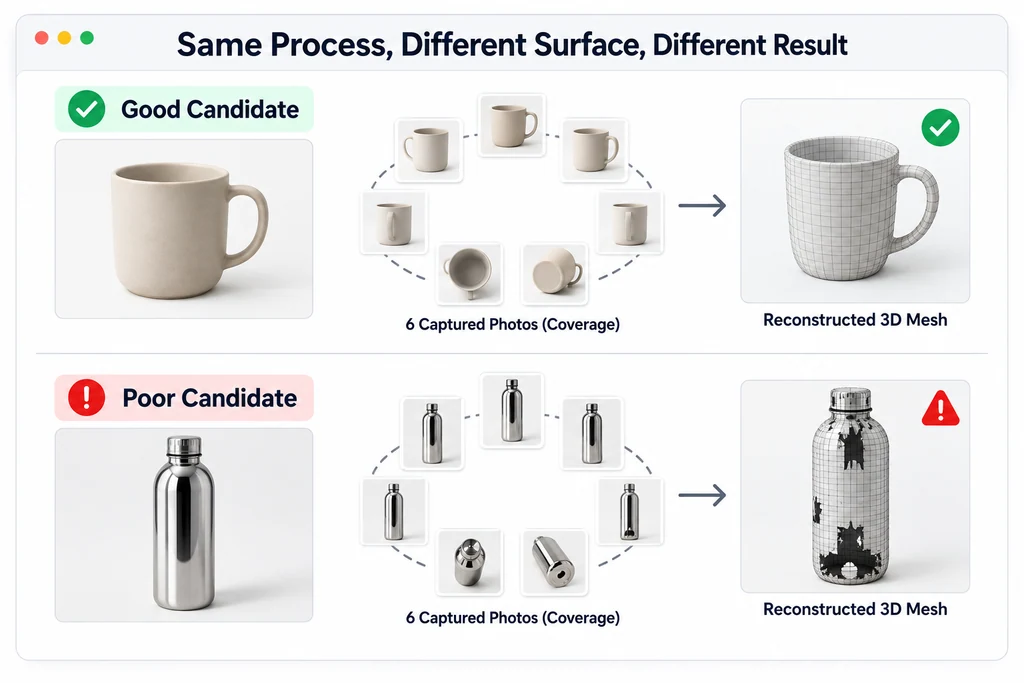
Apple Object Capture is a reconstruction workflow. Do not describe it as Apple Intelligence or assume that it recovers engineering dimensions merely because it creates a recognizable surface.
Choose a suitable capture subject
Use a rigid product that can retain its shape throughout capture. Apple's photographing guidance identifies reflective, transparent, very thin, and low-detail surfaces as challenging.
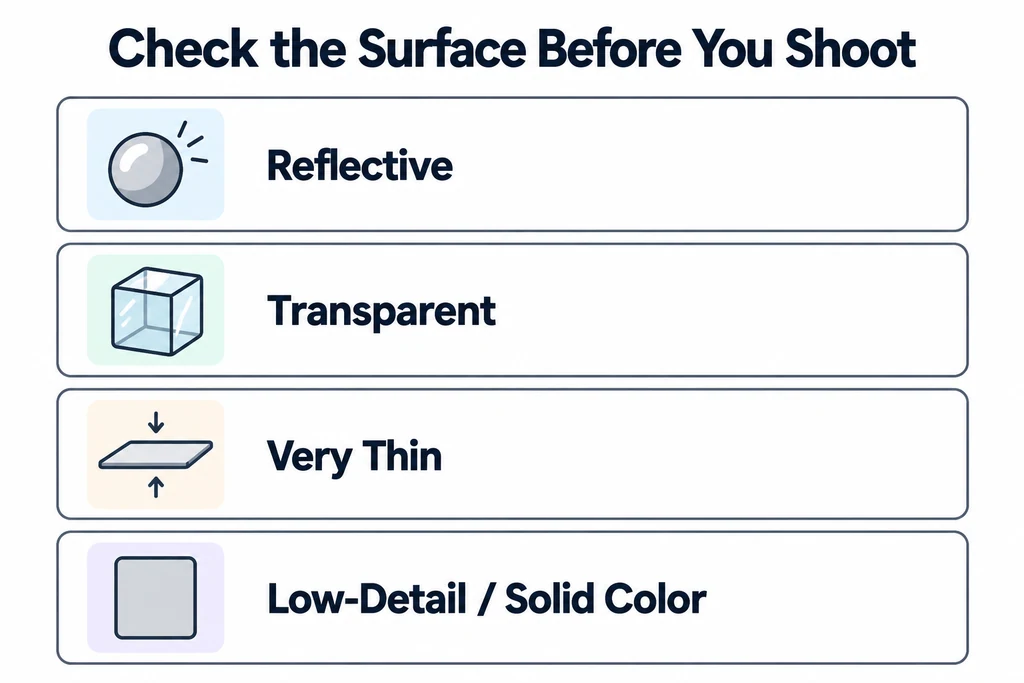
Inspect the object for moving straps, flexible components, and changing reflections. Decide whether the intended result requires those regions. If a critical region cannot be captured reliably, consider a different reconstruction method.
Do not coat, mark, or otherwise alter a valuable product without authorization. A capture aid that changes the finish also changes the appearance evidence.
Plan overlapping coverage
Arrange views around the object and at different heights so neighboring photographs contain common visible detail. Keep lighting sufficiently consistent and avoid strong highlights or hard shadows where practical, following Apple's capture guidance.
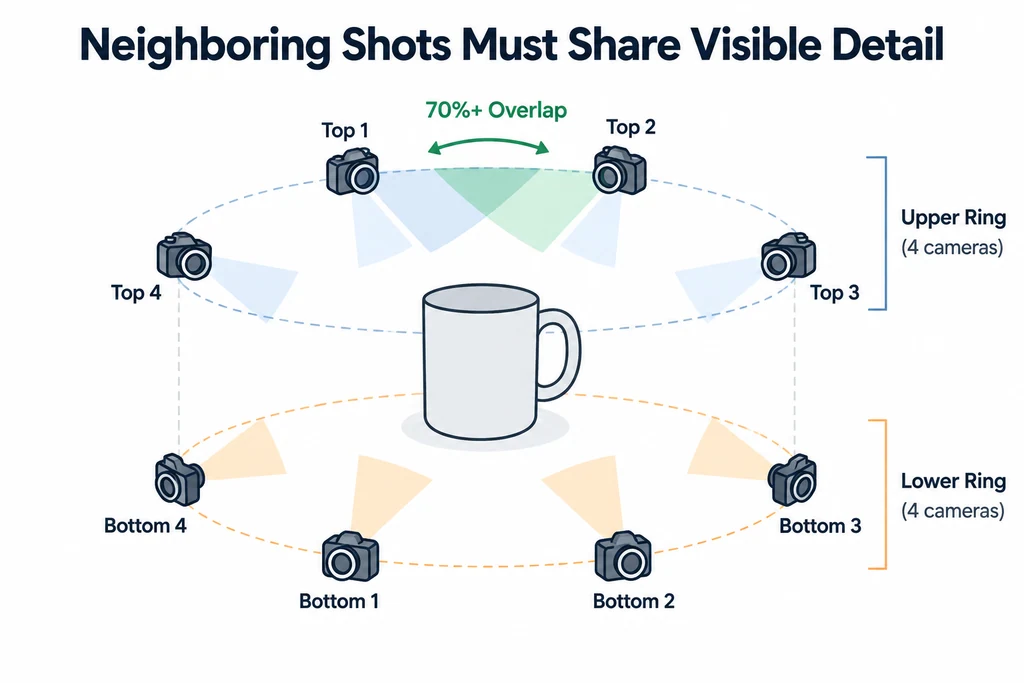
Review coverage of the underside and recesses. Do not assume the software can reconstruct a region that is never visible.
Keep a reference dimension and photographs of identifying details. These support later review even when the reconstruction appears plausible.
Capture a small trial before investing in the full set. Examine the images for focus, movement, exposure problems, and missing regions. Replace poor inputs instead of assuming more photographs will compensate for them.
Decide when to rebuild instead of collecting more photographs
| Surface | Capture difficulty | Practical decision |
|---|---|---|
| Rigid, textured matte surface | Usually offers more stable visual correspondence. | Run a trial and inspect coverage and dimensional accuracy. |
| Polished metal | Reflections move between views. | Consider manually modeled geometry with separately authored material response. |
| Clear glass | Background and reflections can dominate the evidence. | Evaluate another modeling method for the transparent form. |
| Smooth dark plastic | Few visible features and poor shadow detail can weaken reconstruction. | Improve controlled illumination, test again, and rebuild critical regions if needed. |
| Flexible or moving part | Shape differs between photographs. | Stabilize it with permission or capture and model it separately. |
These are selection decisions, not guaranteed outcomes. Extra images cannot supply a hidden underside or make inconsistent reflections into fixed surface features.
After reconstruction, preserve the raw result. Clean a copy, rebuild critical openings or silhouette regions, prepare delivery UVs, and review material maps under new lighting. A reconstructed color texture can contain capture illumination. It should not automatically be labeled measured albedo or treated as a complete PBR material set.
Review the reconstruction as a new asset
Inspect the shape from views beyond the initial camera. Check holes, fused parts, softened edges, and background fragments. Compare the result with the known dimensions and the physical object.
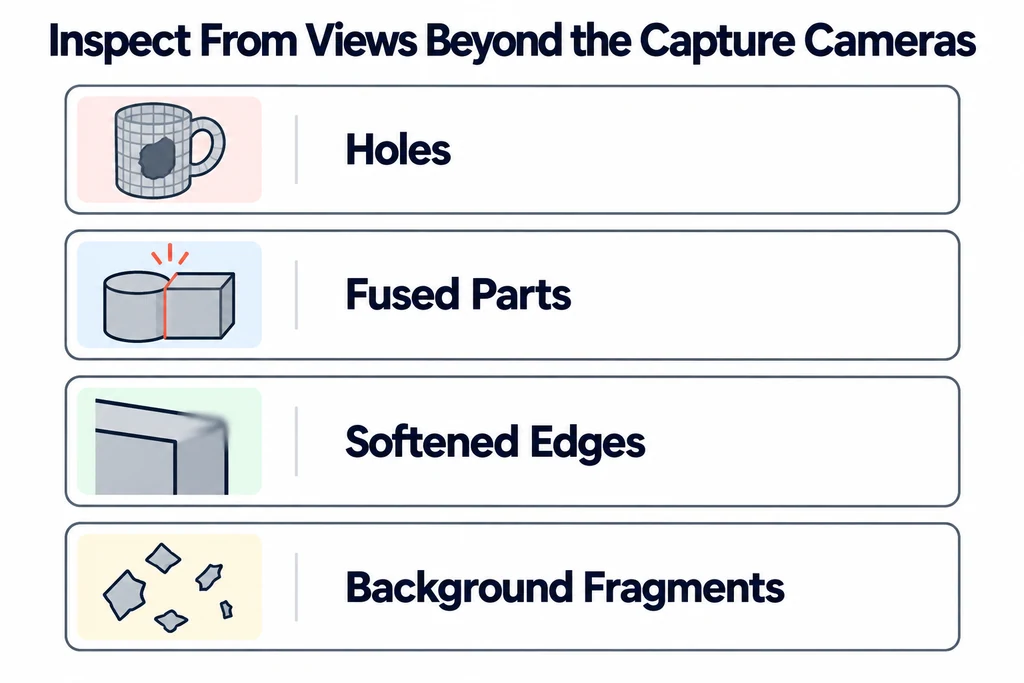
Distinguish captured surface color from a clean relightable material. Lighting present during photography can remain in the reconstructed appearance. Do not call inferred surface properties physically measured without a separate measurement process.
Record which regions need manual rebuilding. A scan can be a useful source even when it is not suitable for direct catalog delivery.
Review reconstruction separately from delivery
Choose an output and editing path that preserves the information you need. Mesh and attribute handling differ between delivery formats, as illustrated by the PLY loader documentation. Do not assume every export contains the same color or surface data.
Clean and optimize a copy, then compare it with the reconstruction. Verify scale again after conversion and inspect the intended final renderer.
Deliver the capture record, reviewed reconstruction, and corrected delivery asset as distinct stages. State any unresolved regions and the approved use. A successful reconstruction supplies a starting surface; a production-ready product asset still requires product and destination review.