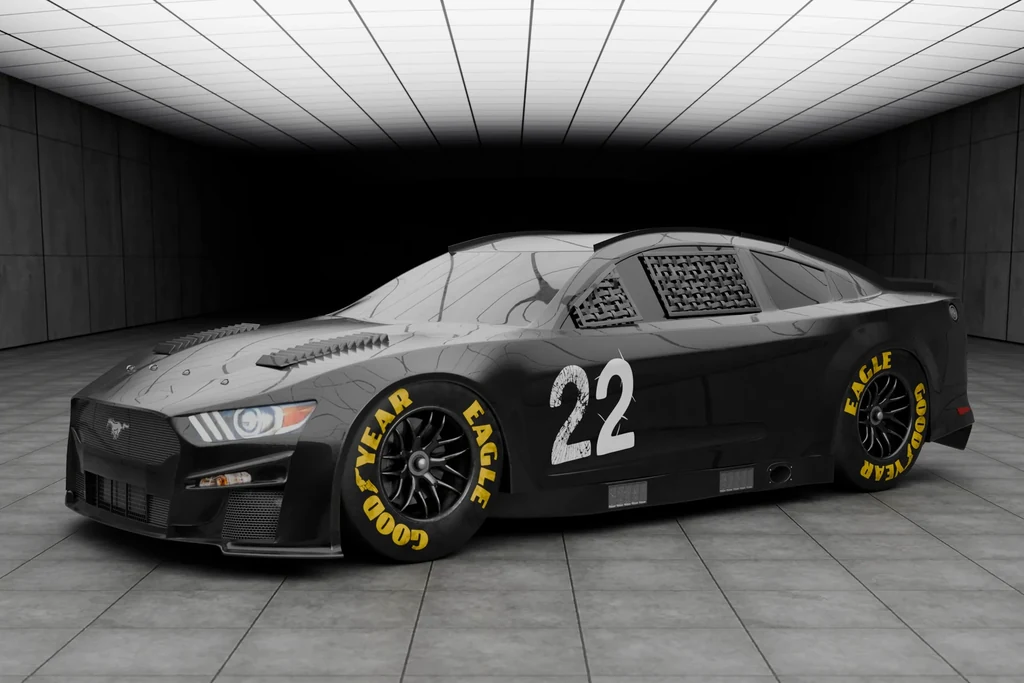
Ford Mustang beauty view showing paint reflections and studio lighting.
View the Ford Mustang project in the Portfolio →
1. The Foundation of Commercial PBR LookDev
In commercial visualization, Look Development (LookDev) connects geometry, materials and lighting into a deliberate visual direction. For complex products such as automotive bodies, watches and consumer electronics, the result benefits from testing material response under controlled reference views.
The Ford Mustang images in this article are portfolio views used to discuss that review process. They illustrate studio, composite, clay and wireframe presentations; they do not by themselves establish a particular renderer, shader graph, paint formulation or production specification.
Key Principle: Lighting Reveals Geometry
Shaders do not exist in a vacuum. A shader only looks as good as the light gradients bouncing across its surface. Controlled broad reflections can reveal discontinuities in surface curvature. Compare several light directions and inspect the source geometry when a highlight suggests a problem.
2. Multi-Layer Metallic Car Paint: Flakes, Basecoat & Clearcoat
Automotive finishes are often approached as a combination of color, metallic response and a clear protective surface. The exact implementation depends on the target renderer and the approved material references:
Base color: Establishes the intended hue and value before lighting is evaluated.
Metallic response: Is tuned against reference lighting so highlights retain the intended character.
Clearcoat response: Adds a separate glossy surface whose reflections make curvature and roughness easier to assess.
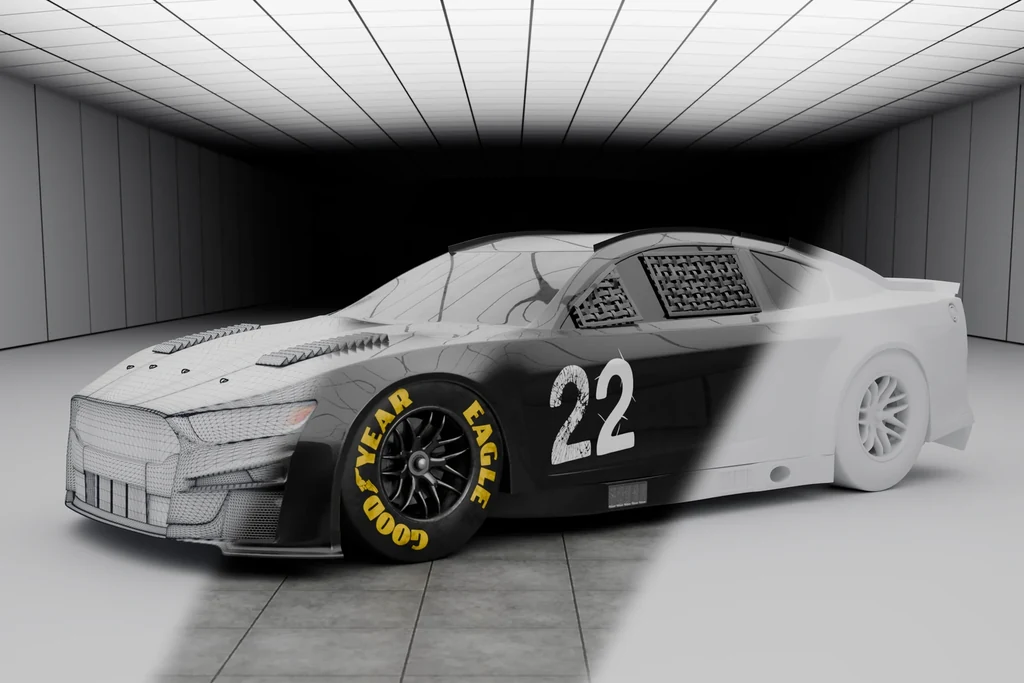
Composite comparison of wireframe, shaded and clay views of the same Mustang.
A composite comparison helps separate material appearance from geometry inspection. It should be treated as a review aid, not as evidence of a manufacturing color match or a particular material implementation.
3. Studio Lighting Architecture & Highlight Sculpting
Lighting an automobile or product in a studio setting is an exercise in highlight sculpting. Rather than blasting the subject with uniform illumination, lighting rigs can be arranged around distinct inspection roles:
Key Light (Main Sweep)
A large overhead softbox strip that casts an unbroken longitudinal highlight along the roof, hood, and trunk lines, delineating vehicle proportion.
Rim / Edge Kickers
Low-angle, high-intensity gradient strips positioned perpendicular to the wheel arches to carve the silhouette out from darker backdrop shadows.
Fill & Ground Bounce
Subtle gradient bounce cards simulating ambient ground reflections, preventing underside undercarriages from crushing into pure black.
4. Clay Render Validation: Pure Geometry & Surface Tension
A neutral clay pass is a useful review before final beauty rendering. A matte material reduces the competing effects of paint reflections and texture maps so the artist can inspect the geometric form.
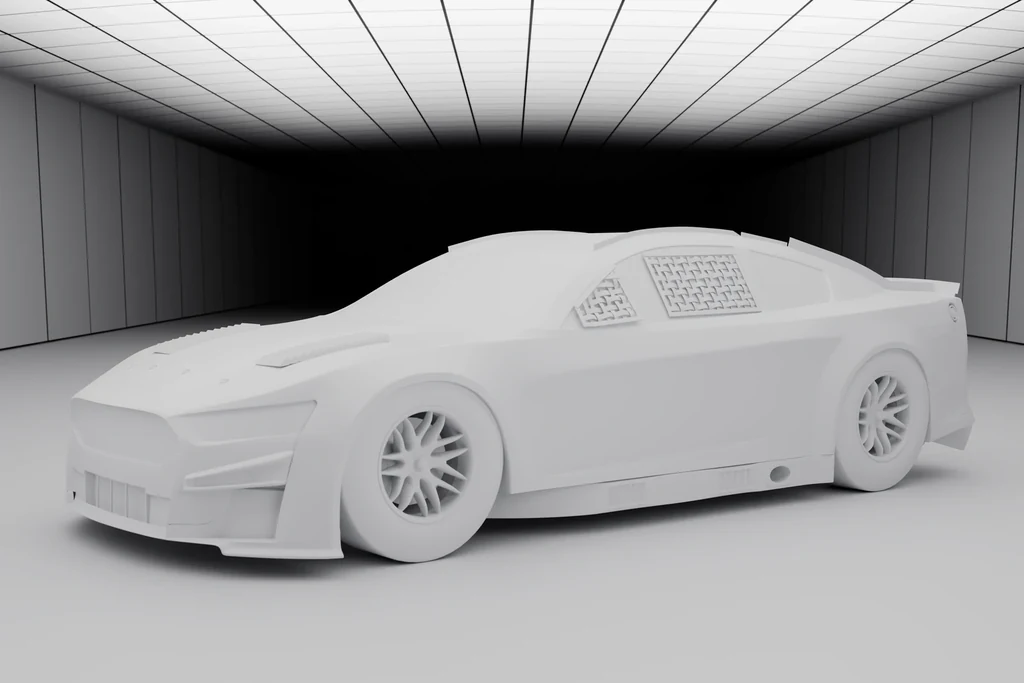
Neutral clay view used to inspect silhouette, panel gaps and surface transitions.
In a clay view, artists can inspect the silhouette, panel gaps and broad surface transitions without paint reflections competing for attention. A clean result in this view supports the next material and lighting review; it does not replace inspection of the source model.
5. Wireframe View & Surface Review
A wireframe image is useful for locating density changes and evaluating the rendered surface. This inspection image visibly shows triangulation; that may reflect display or export triangulation and does not, by itself, prove the authoring topology or the absence of mesh issues.
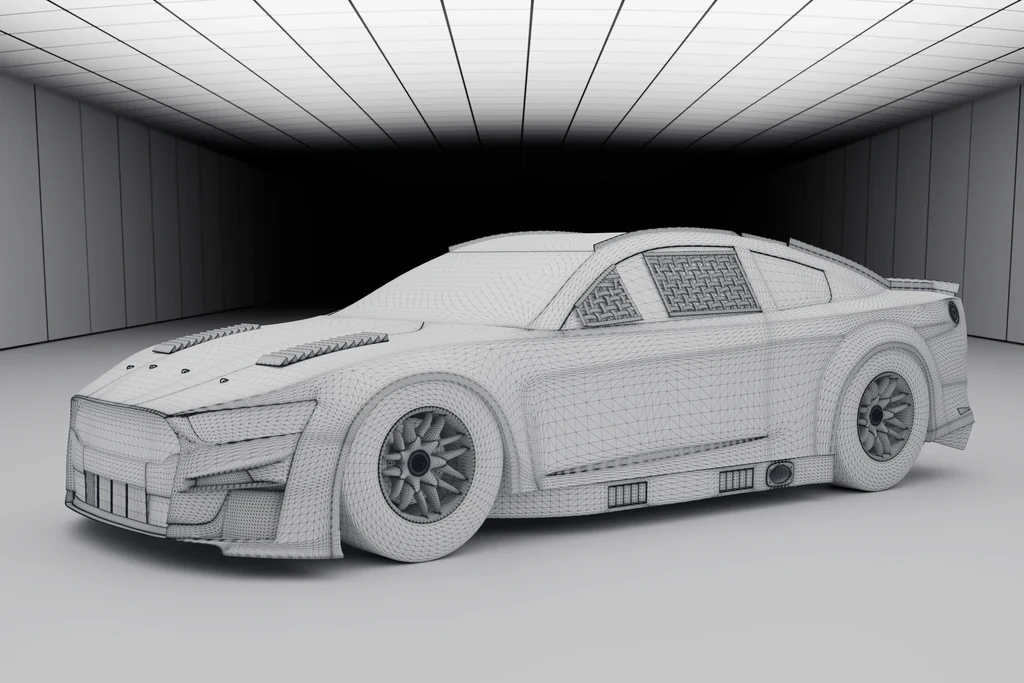
Wireframe view showing the triangulated surface used in this inspection image.
Useful questions for a topology review include:
Shading continuity: Do highlight transitions stay clean around panel breaks and wheel openings?
Density placement: Is detail concentrated where the silhouette or deformation requires it?
Authoring data: Does the source model confirm the intended loops, subdivision behavior and manifold state?
6. Frequently Asked Questions
Why is studio lighting on a clean white background preferred for commercial LookDev?
A clean studio environment reduces background distraction so teams can compare paint, glass and wheel appearance under a deliberately chosen lighting setup.
Can these high-end LookDev models be optimized for WebGL and WebAR?
A carefully authored real-time derivative can preserve the silhouette, material identity, and important surface detail of the offline asset. The result should be evaluated with agreed reference views and an explicit performance budget rather than a generic fidelity percentage.