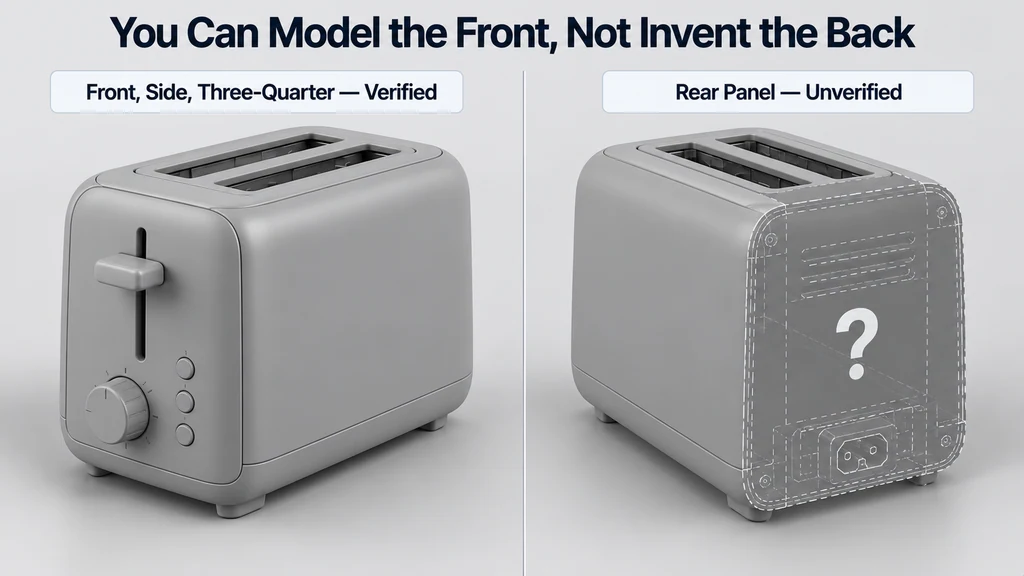
Consider a countertop appliance supplied as front, side, and three-quarter photographs. The body width is known, but the rear panel is absent. You can begin the exterior blockout. You cannot present an invented rear connector layout as a verified representation of the manufactured product.
Establish a reference hierarchy
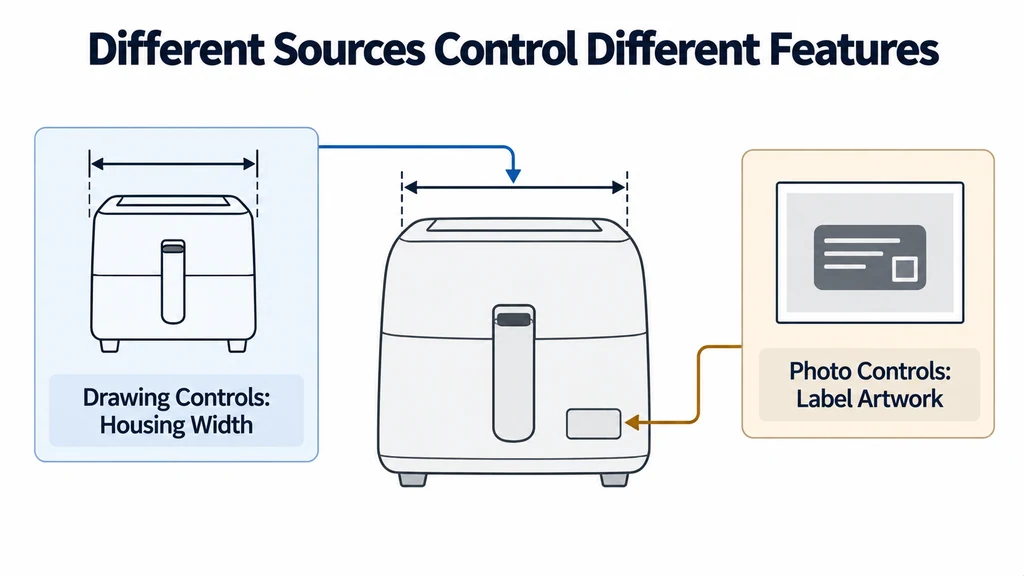
Keep the original images and drawings unchanged. Record which product revision they depict, who supplied them, and which dimensions have an authoritative source. A dimensioned drawing can control the housing width while a recent photograph controls the label artwork. Resolve conflicts with the product owner rather than averaging contradictory references.
List missing facts separately. Distinguish a hidden cosmetic seam from a missing mounting interface. Both are unknown, but the interface may determine whether the entire model is suitable for its intended use.
Match the camera before changing the model
Start with simple volumes at the known dimensions. Compare the blockout with each reference through a suitable camera. Blender documents perspective and orthographic camera models in its camera reference. Do not force an orthographic model view to match a photograph with obvious perspective.
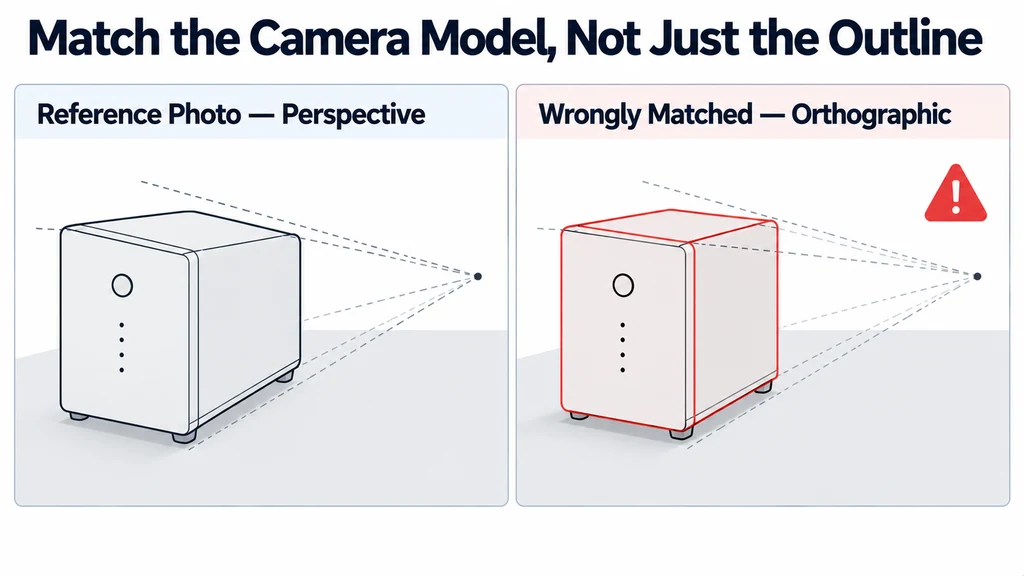
If the front face matches but the rear edge does not, examine camera position and framing before stretching the object. Preserve the confirmed width while adjusting the comparison. A single reference may admit several plausible shapes, so check every change against another view.
For drawings, confirm that the views share a scale and revision. A screenshot of a drawing is not automatically a calibrated measurement surface. Use stated dimensions rather than measuring pixels unless the reference has been verified for that purpose.
Add detail only after the blockout passes
Approve the overall proportions, footprint, openings, and major component boundaries in neutral shading. Then add the features that the planned views expose. Keep uncertain components separate so a later correction does not require rebuilding the whole object.
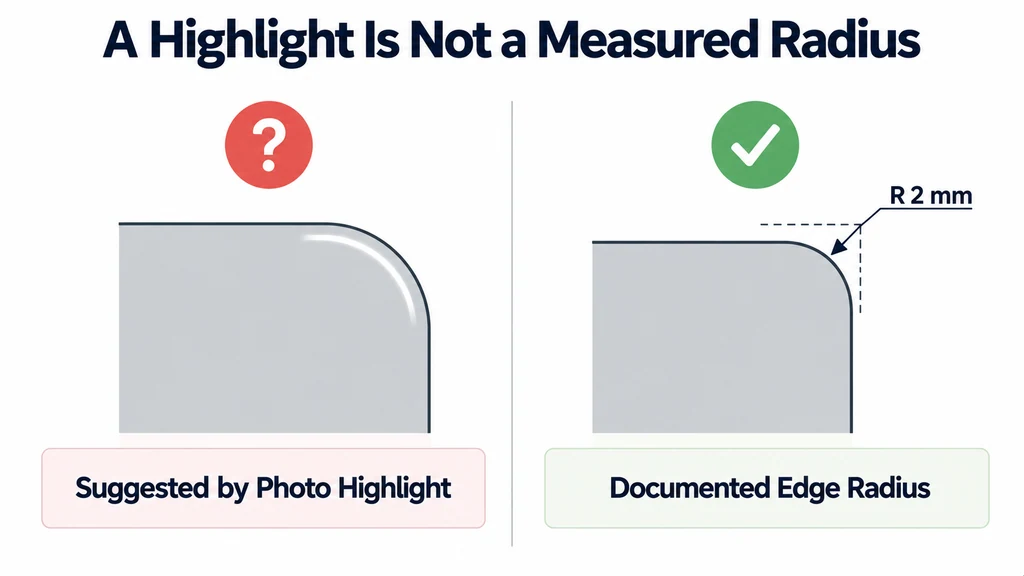
Use edge treatments appropriate to the reference. The Bevel modifier offers geometric control, but its available settings do not determine the correct radius for a product. Match the documented construction or request a close photograph. An attractive highlight is not evidence of the manufactured edge.
Give each modeled feature an evidence status
For the appliance example, keep the measured housing width, photograph-derived seam placement, and unknown rear connectors as separate entries. Use the known width to constrain the blockout while matching the reference camera. Do not distort that width to force every edge into a single photograph.
| Evidence status | Modeling decision |
|---|---|
| Confirmed by a dimensioned source | Preserve and verify the dimension after export. |
| Visible in several consistent photographs | Reconstruct the appearance and compare across views. |
| Visible only through perspective or reflections | Keep the estimate reviewable and request another view if needed. |
| Absent from every reference | Omit, constrain the viewing scope, or obtain approval for a clearly labeled approximation. |
Approve those choices before detailed materials and bevels. A neutral side or rear view can expose a proportion error that a polished hero frame conceals. Keep the reference index with the editable scene so later revisions can distinguish corrected facts from new estimates.
Review uncertainty as part of the delivery
Supply front, side, and three-quarter comparisons with the controlling dimensions identified. For each unresolved feature, state whether it was omitted, approximated for a limited view, or approved by the product owner. Restrict the permitted camera range when an unseen region remains unverified.
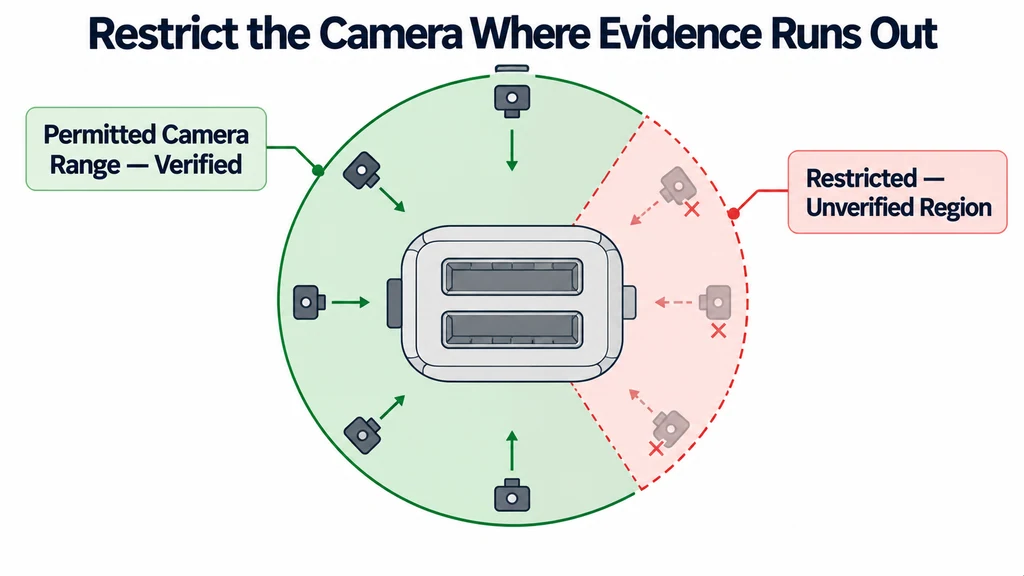
Before accepting the model, inspect a view that was not used for the initial match. This can expose a shape that fits one photograph but fails spatially. Deliver the reference index and approved assumptions with the editable scene. The recipient should be able to distinguish reconstructed appearance from confirmed product geometry.