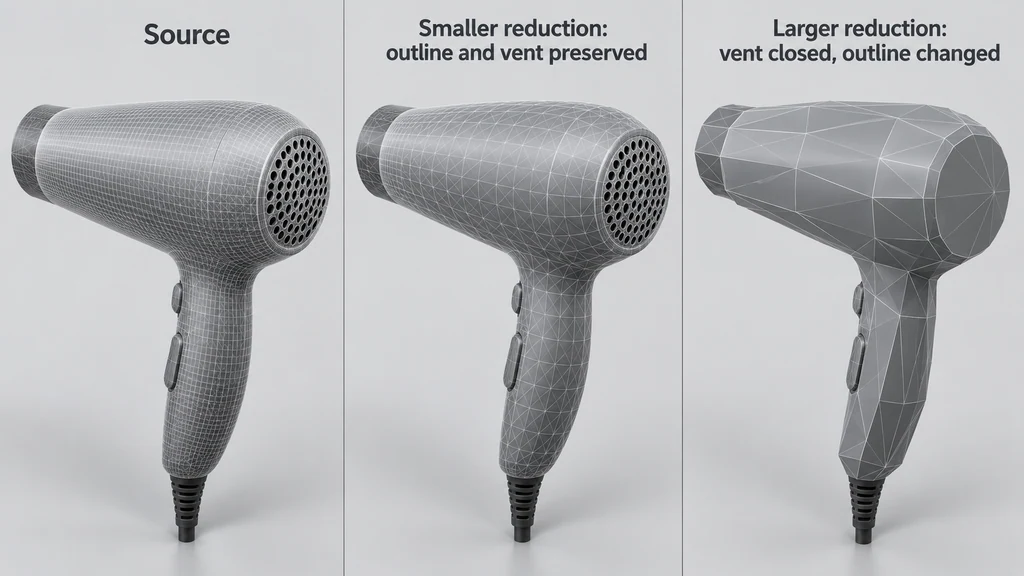
A smaller mesh is useful only if it still represents the product it was built to show. A reduced triangle count can conceal a closed vent, an angular curve or a misaligned part. For a 3D Vision Art asset review, the shape requirements should be clear before choosing how far to simplify.
Define what must remain
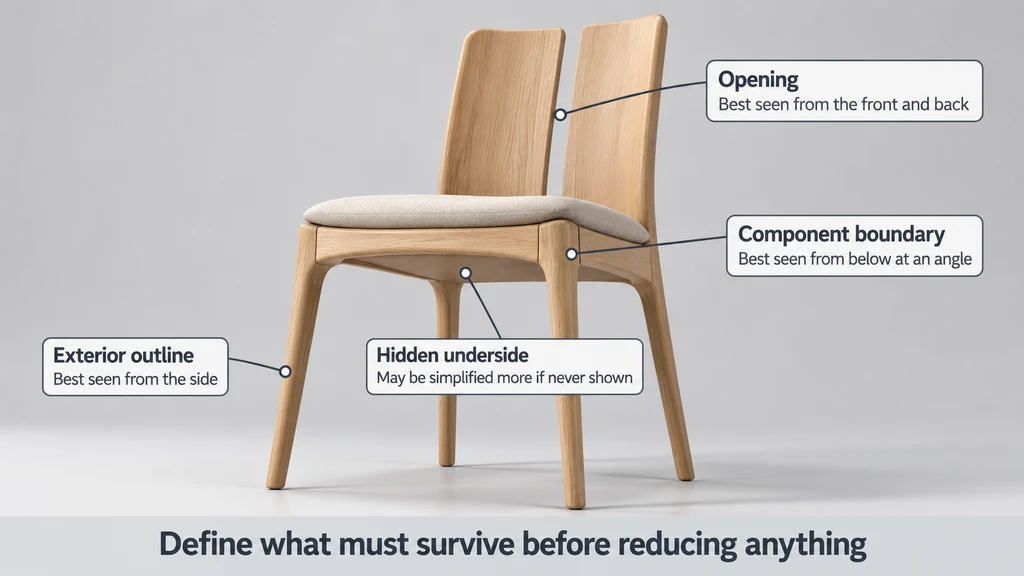
Identify the outline, visible openings, contact areas and boundaries between components. Include any clearance needed by moving parts. Mark which details can be omitted at the intended viewing distance.
Keep a reviewed source mesh. It is the reference for the reduced candidates, including the regions that look unimportant in a single camera angle.
Compare separate candidates
Create reductions from the same source and keep the settings with each version. Repeatedly simplifying an already reduced mesh can accumulate changes that become difficult to trace.
Use the simplifier's documented controls, including its error limits where available. A target percentage is a setting to test, not a guarantee that a product will remain visually acceptable.
Check shape before finish
Use a plain background to compare silhouettes. Look through holes and narrow gaps from several angles. Inspect thin sections and circular openings for collapsed or visibly faceted geometry.
Then use neutral shading to check surface transitions. Restore the final materials afterward and inspect reflections, UV distortion and labels. A convincing glossy preview should not be used to excuse an altered outline.
Record a shape-based acceptance test
For each candidate, keep the same front, side, three-quarter, and detail views. Overlay the silhouette or alternate between versions. Inspect openings with a contrasting background so a closed vent or collapsed gap remains visible.
| Region | Acceptance evidence |
|---|---|
| Outer curve | No unacceptable faceting at the agreed camera distance. |
| Hole or vent | Opening and visible wall thickness remain readable. |
| Part boundary | Components remain separate where selection or motion needs them. |
| Label region | UV placement and lettering retain the approved proportions. |
The simplifier's error limit is an algorithmic control, not a direct promise about image-space difference. The simplify documentation also explains that topology can prevent a requested ratio from being reached. Record the achieved result rather than reporting only the requested percentage.
Keep the original approved mesh and derive each candidate from it. Reject a smaller candidate when it changes product construction, even if the texture hides that change under one lighting setup.
Measure the exported result
Open the final file in its destination renderer and repeat the intended interactions. Record the actual triangle count and resource sizes. Geometry simplification and data compression are different operations, and each needs the appropriate review.
If textures dominate memory or transfer size, fewer triangles may not solve the main delivery cost. Keep the least costly candidate that still meets the shape requirements, and retain the source for future revisions.