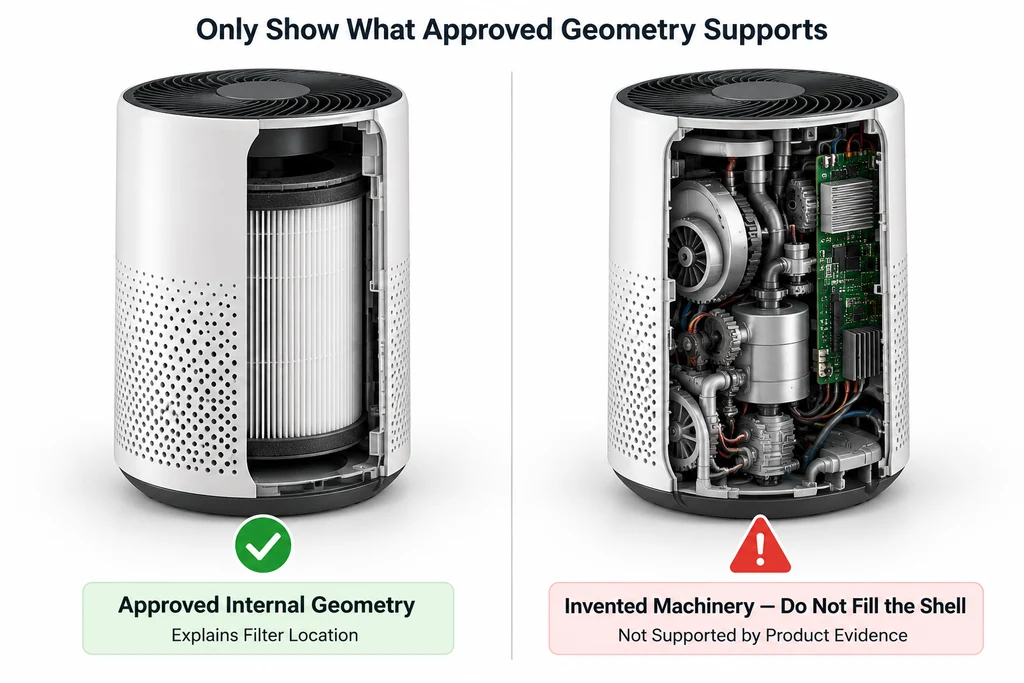
Define the question before choosing the cut. A view that explains the location of a filter may need a small section through the housing. A view that explains an entire assembly may require a different sequence. Removing more material does not necessarily make the explanation clearer.
Establish what may be shown
Identify the product revision and the owner of the internal design. Ask which parts may be exposed publicly and which relationships are approved for depiction. Keep confidential geometry out of the delivery scene when the audience does not need it.
Mark simplified parts explicitly in the review. A representative screw or omitted wire bundle may be acceptable for a marketing explanation, but the reviewer must understand what changed. Do not present the film as assembly or maintenance instruction unless the responsible manufacturer has approved that use.
Create a presentation copy of the assembly
Preserve the source model. Build the cutaway on a presentation copy with stable component names and a record of the removed regions. Blender's Boolean modifier can perform a difference operation, but inspect the resulting surfaces rather than assuming the operation produces a finished presentation mesh.
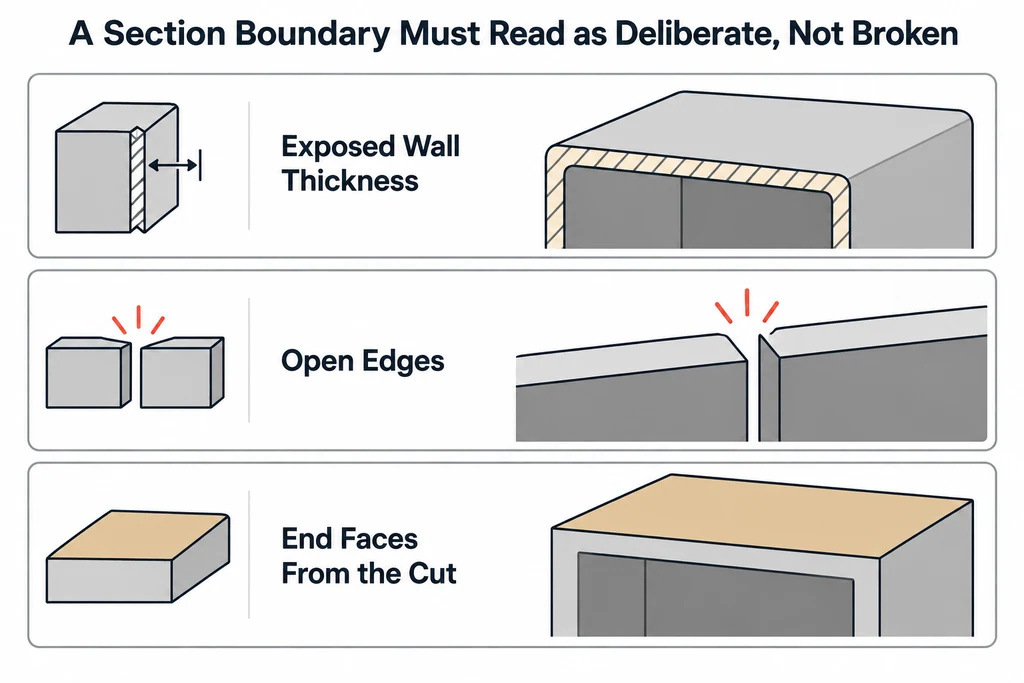
Check exposed wall thickness, open edges, and the end faces created by the cut. A section boundary must read as a deliberate illustration, not as broken geometry. Use a consistent treatment for cut surfaces and confirm that the treatment does not resemble a material actually sold with the product.
Choose the cut position by the feature being explained. Do not move an internal component just to improve the composition without documenting that displacement.
Choose a reveal method for the explanation
| Technique | Useful purpose | Production check |
|---|---|---|
| Mesh Boolean | A physical-looking section through known geometry. | Topology, caps, wall thickness, and stability during motion. |
| Renderer-specific clipping | A moving section without rebuilding the same mesh each frame. | Cap treatment, shadows, and support in the actual renderer. |
| Hidden or ghosted housing | Show component relationships without a literal section. | Transparency sorting, readability, and a clear visual distinction from the real product. |
Clipping and ghosting are presentation methods. They do not automatically produce a closed physical mesh or an exportable effect in every delivery format.
Choose the least complicated method that exposes the approved mechanism clearly. Hold the exterior long enough to establish orientation, reveal the interior, then show the relevant motion. Avoid making all three changes at once if they obscure cause and effect. Inspect every transition for unsupported intersections or disappearing parts before rendering the finished sequence.
Review the transition into the cutaway
Show enough of the exterior first for the audience to understand orientation. Then reveal the internal region without changing the viewpoint so abruptly that the viewer loses its relationship to the whole product.
Assemble the rough sequence on a timeline. Watch whether the reveal conceals an important action. If a component begins moving while the housing disappears, separate the events or hold the camera so both remain understandable.
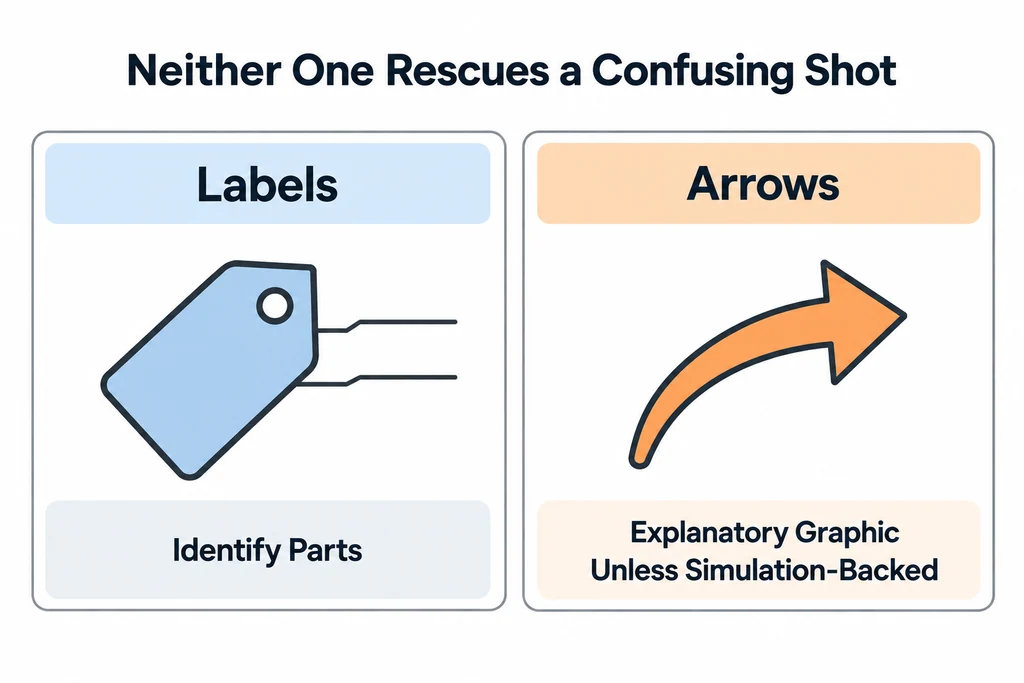
Use labels to identify parts, not to rescue an incomprehensible arrangement. Review arrows and flow graphics with the product owner. An animated arrow is an explanatory graphic unless a documented simulation supports the specific physical behavior shown.
Check the final explanation
Ask a reviewer unfamiliar with the scene to identify the mechanism and describe its action. Compare that description with the intended message. Correct ambiguity before increasing visual polish.
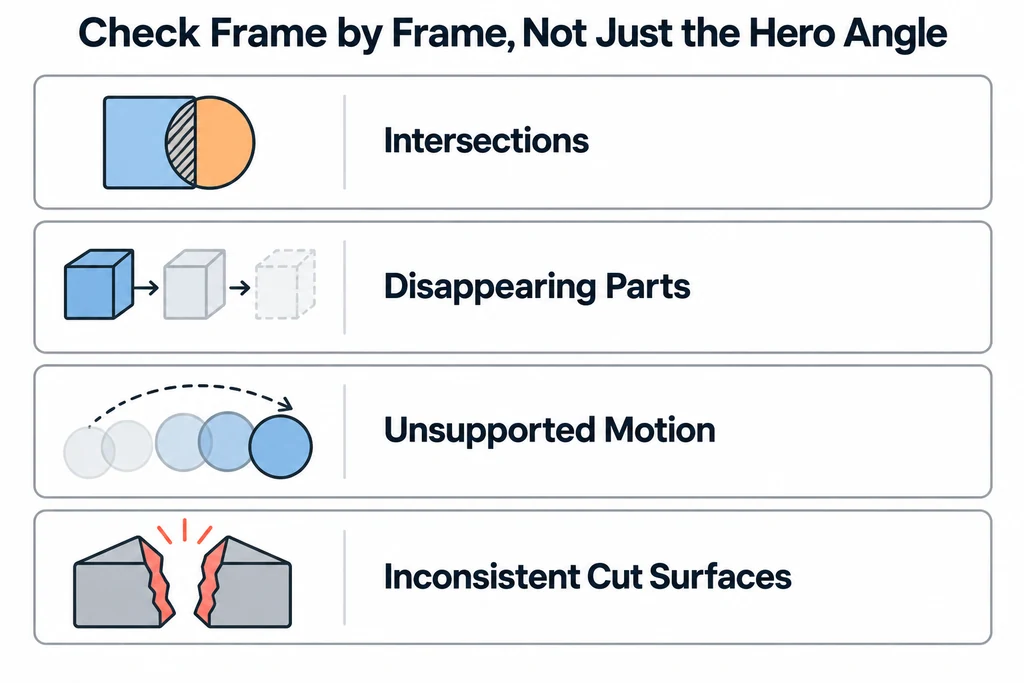
Then inspect the film frame by frame for intersections, disappearing parts, unsupported motion, and inconsistent cut surfaces. Keep a record of the approved geometry revision and simplifications with the final sequence. The result should make the mechanism understandable without asking the audience to mistake an illustration for engineering validation.