Choose the production method around the product evidence, required views, variants, and update cycle. Photography records a physical sample. CGI creates an authored representation that can be revised and reused. A project can benefit from both, with different responsibilities for accuracy and approval.
Compare the source requirements first
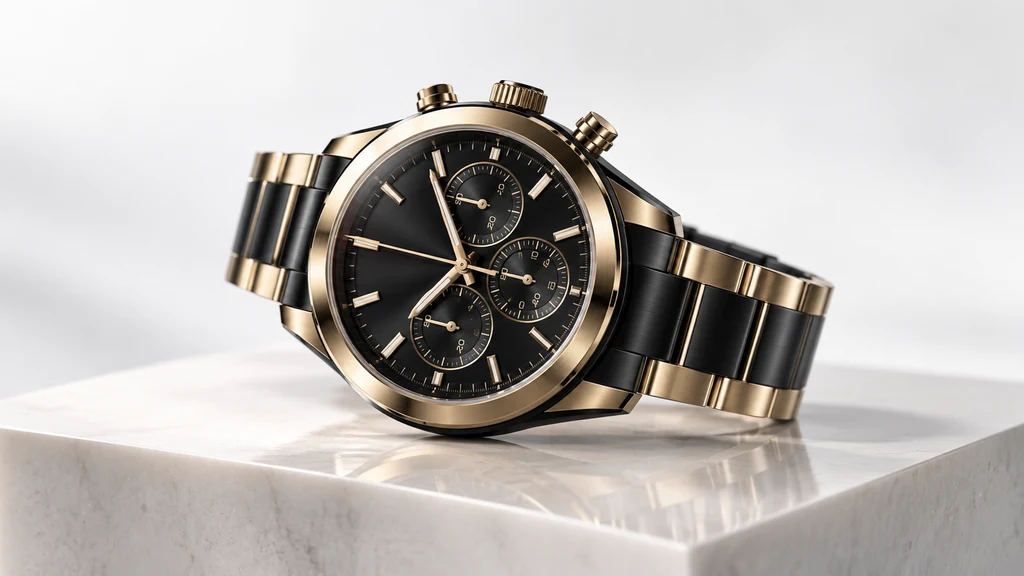
Photography needs a physical subject or an agreed compositing approach. That can be valuable when the real sample's surface character is difficult to describe. The capture still depends on lighting, camera, styling, color management, and retouching decisions.
CGI can begin from approved CAD, dimensions, drawings, or photographs. Those inputs may allow work before a finished physical sample is available. They do not remove the need to resolve missing labels, finishes, rear details, or construction changes.
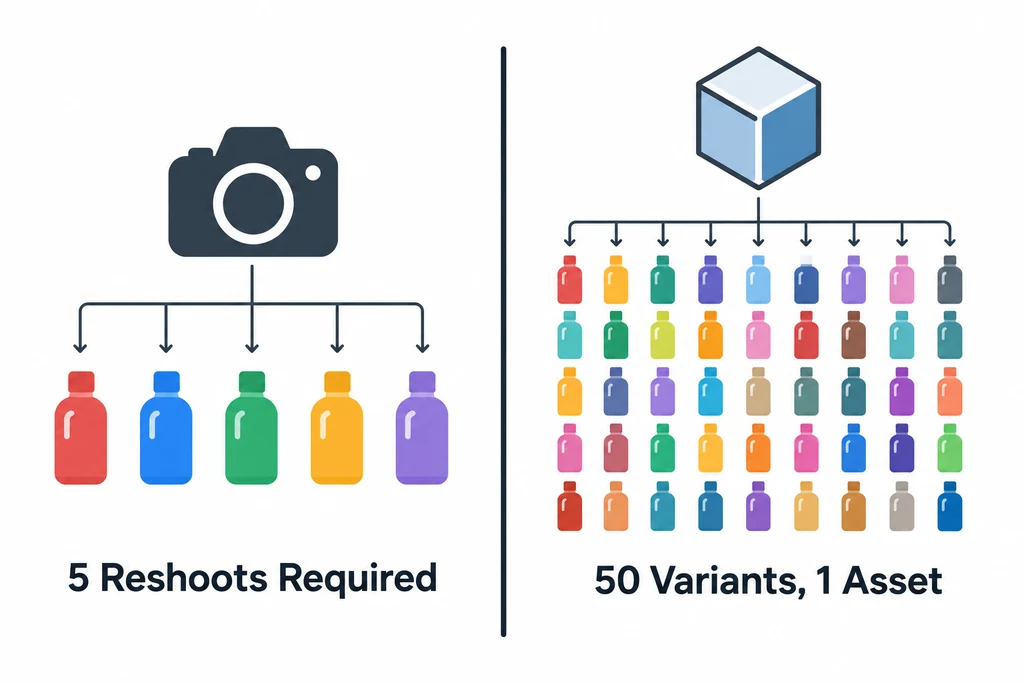
Avoid treating every revision as a new shoot or every digital variant as instant. A photographer may reuse a controlled setup or retouch a limited change. A 3D team may need to rebuild geometry, author a new finish, or rerender dependent outputs. Scope the actual change.
Separate reusable assets from finished outputs
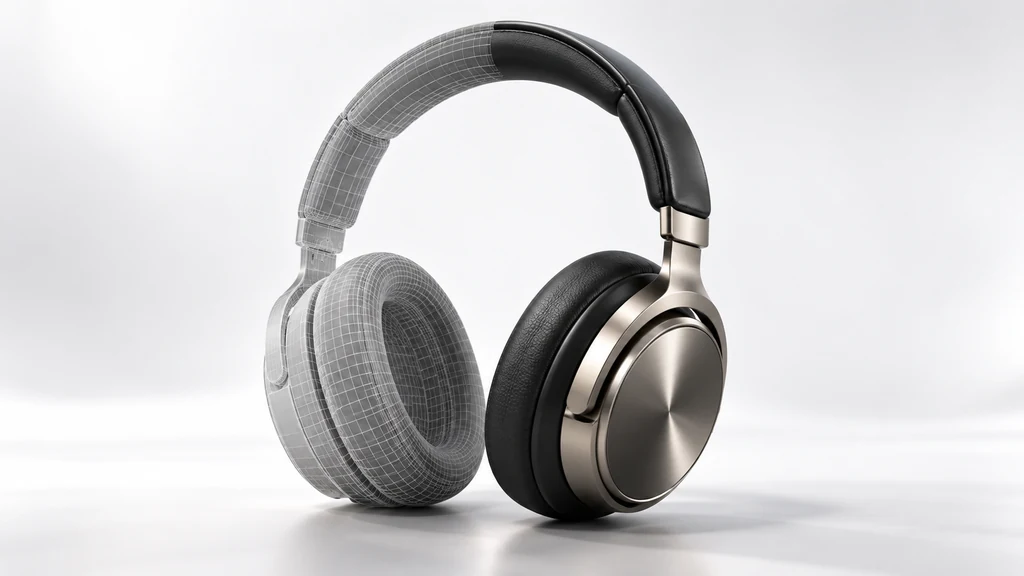
An approved digital model can support several camera views and material states. Saved lighting and cameras help maintain a catalog's visual rules, while product families still need review for proportions, framing, and finish.
The reusable source and the delivered image are separate items. Agree whether editable scenes, textures, later variants, or additional formats are included. A contract for still renders does not automatically include a web-ready model or every source asset.
Use a comparison tied to the job
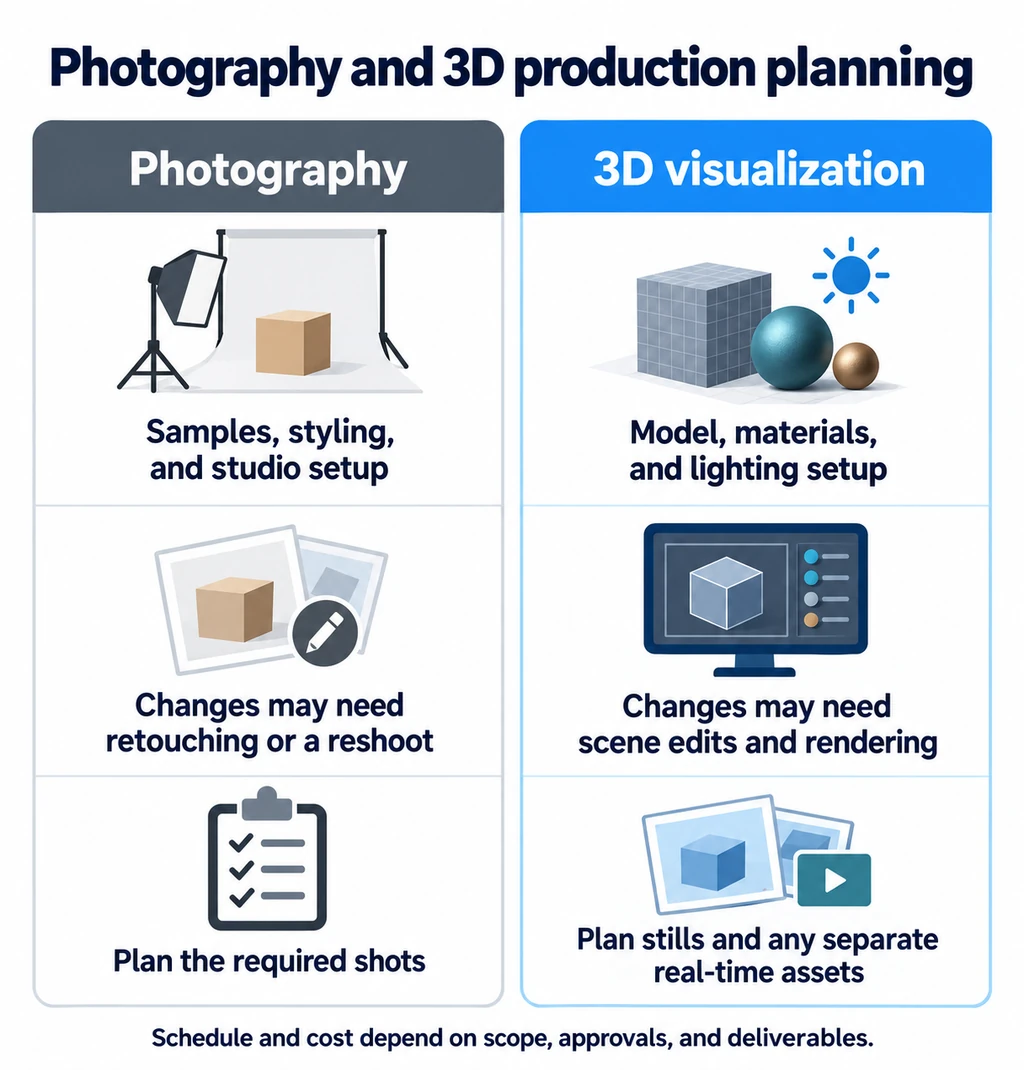
| Production question | Photography | CGI |
|---|---|---|
| What establishes the product? | The physical sample and its capture record. | The approved references and authored geometry and materials. |
| What is needed before production? | Sample availability, styling, lighting, and shot planning. | Suitable source data, reference decisions, and modeling or preparation. |
| How do variants affect work? | Additional samples, capture, or an approved retouching method. | Material or geometry changes, rendering, and review. |
| What does a design revision affect? | Relevant captures and retouched outputs. | Source assets and every dependent output. |
| What can be reused? | Approved photographs and controlled capture setups where suitable. | Approved scenes and derivatives that remain valid for the product. |
| What supports interactive inspection? | A planned image sequence can supply a controlled spin. | A separate engineered real-time asset can supply supported interaction. |
This is a scope comparison, not a price or turnaround benchmark. Estimate both routes against the same shot list, revision assumptions, material complexity, and delivery requirements.
Plan interactive delivery as additional production work
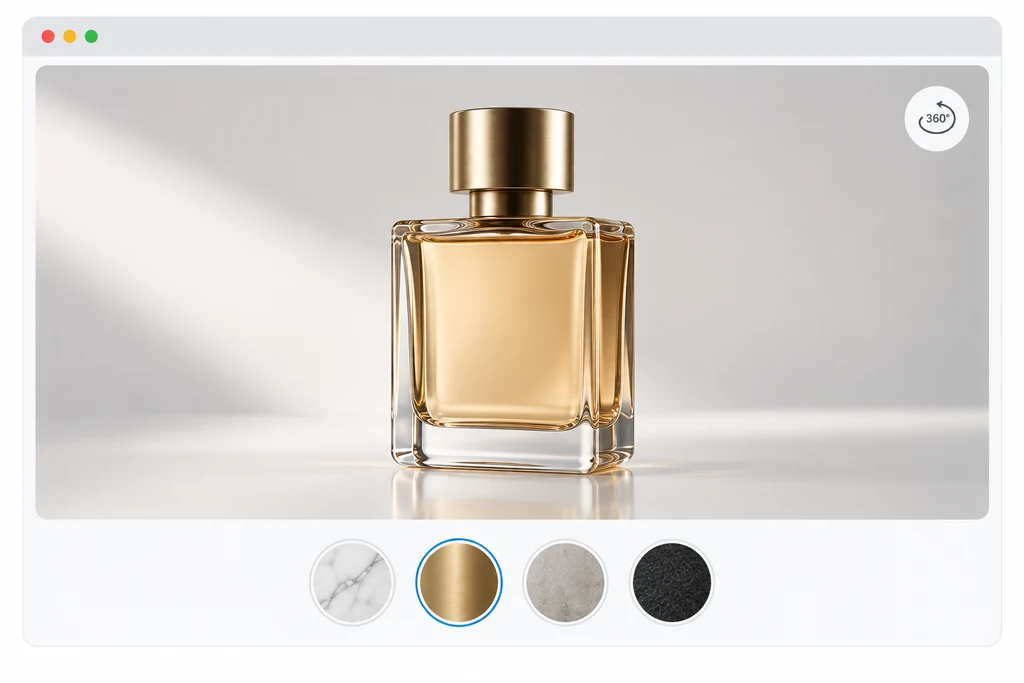
A high-resolution render scene can be a useful source for a real-time derivative. The web asset still needs suitable geometry, texture sizes, supported materials, and behavior. A format conversion alone does not establish that it loads efficiently or preserves the approved finish.
Use the target viewer's lighting and color pipeline when reviewing that derivative. Keep product choices aligned with SKU data, and test a separate AR package when the page offers one. A supported placement preview can help communicate approximate spatial context; it does not replace published dimensions or prove physical fit.
The glTF specification and GLTFLoader documentation describe the delivery format and one receiving implementation. Storefront support, including Shopify product media, needs checking for the selected integration.
Approve the pipeline with a representative product
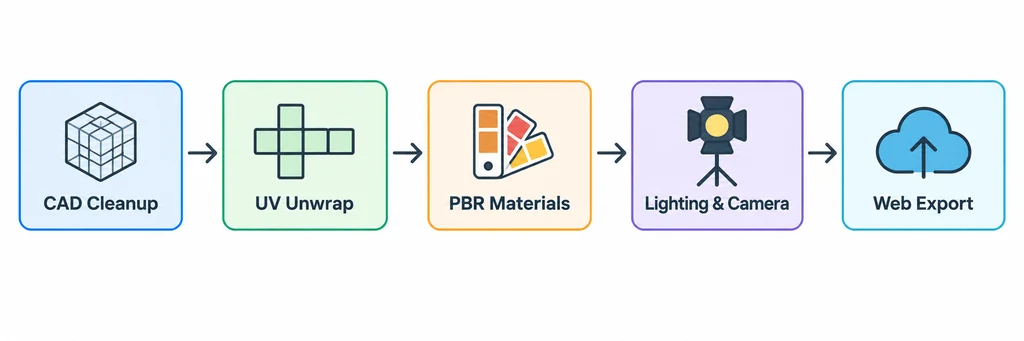
Start with a representative SKU and its difficult material or detail. Agree the dimensions, source authority, required views, and review stages before producing the wider catalog.
For CGI, approve shape in neutral views, then materials under controlled lighting, then final composition and outputs. A clean quad layout can be useful during authoring, but it is not a universal requirement for every tessellated or delivered mesh. The relevant test is whether the source remains editable as needed and the final output meets its visual and technical requirements.
For photography, record the sample state, camera and lighting setup, and the retouching boundaries. Preserve approved captures and edits so later work can distinguish a product change from a change in presentation.
Evaluate cost and commercial impact separately
Compare complete production costs, including preparation, variants, revisions, rendering or capture, retouching, integration, and maintenance. A large variant set may offer reuse opportunities, but the break-even point depends on the actual work.
Measure storefront outcomes in a controlled rollout where practical. Compare eligible visitors offered the new experience with an appropriate baseline. Track purchases, loading cost, and relevant return reasons. A higher engagement rate among visitors who choose to use 3D does not by itself establish that 3D caused more purchases.
Frequently asked questions
Can CGI replace every product photograph?
It depends on the intended evidence and output. Physical samples can remain valuable for difficult finishes, tactile details, and reference approval. CGI can supply controlled variants and views when the representation is supported by the source data.
Is one method always cheaper?
No. Request estimates for the same product states and outputs, including updates and ownership terms. A comparison based only on the price of one image hides reusable work and later maintenance.
Can the same model serve a website and AR?
A shared source can supply those derivatives. Each output needs its own material, resource, format, and destination review. Do not assume that an offline beauty render demonstrates an approved interactive asset.